


26 June, 2026
What Is GEO (Generative Engine Optimization) and Why Is It Changing SEO?
In recent years, the way users search for information on the internet has changed dramatically. The emergence of AI-powered tools such as ChatGPT, Google Gemini, and Perplexity has transformed how content, products, and services are discovered.
In this new context, a key concept has emerged: GEO (Generative Engine Optimization).
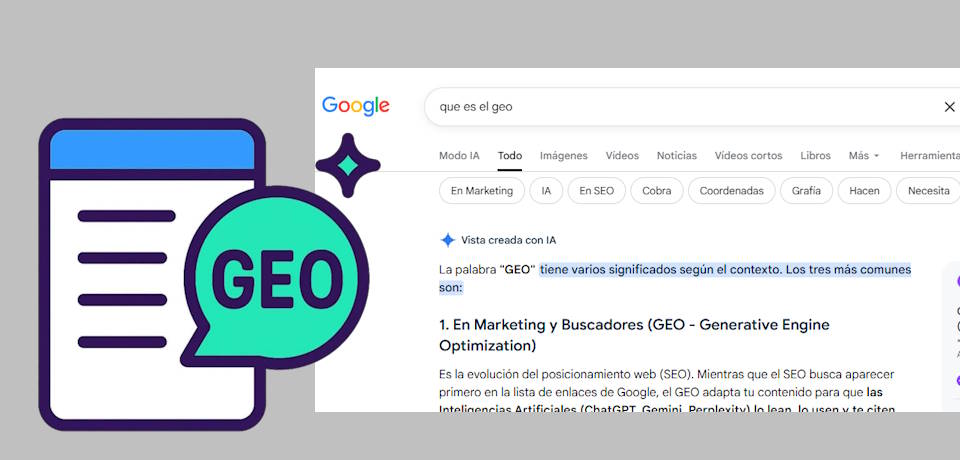
GEO refers to the optimisation of content so it can be understood, interpreted, and used by AI-based generative response engines.
Unlike traditional SEO, which focuses on ranking in search engines like Google, GEO aims to position information within AI-generated answers.
What Is GEO (Generative Engine Optimization)?
Generative Engine Optimization is the set of strategies aimed at optimising content so that it can be used by artificial intelligence systems when generating responses for users.
This includes systems such as:
- ChatGPT
- Google Gemini
- Perplexity AI
- Microsoft Copilot
Instead of showing a list of links, these tools generate complete answers based on multiple sources of information.
Therefore, the goal of GEO is not only to appear on Google, but to become a trusted source within AI-generated responses.
How GEO Works
Artificial intelligence models do not work like traditional search engines. They do not “rank” pages in the same way, but instead analyse patterns, authority, clarity, and content structure.
For content to have a higher chance of being used by AI, it typically meets the following criteria:
- Clear, structured, and well-explained content.
- Direct answers to specific questions.
- Topical authority within a sector.
- Consistency across published information.
- Use of natural and contextual language.
GEO vs SEO: What’s the Difference?
Although they are related, SEO and GEO are not the same.
SEO focuses on improving visibility in traditional search engines like Google by optimising factors such as keywords, links, domain authority, and user experience.
GEO, on the other hand, focuses on how AI models interpret and reuse information.
Traditional SEO
- Optimisation for rankings on Google.
- Focus on keywords and SERPs.
- Importance of backlinks.
- CTR from search results.
GEO (Generative AI)
- Optimisation for AI-generated answers.
- Focus on context and clarity.
- Importance of topical authority.
- Less dependence on traditional clicks.
Why GEO Matters Now
The growth of conversational search is changing user behaviour.
More and more people are asking questions directly to AI systems instead of searching on Google.
This implies a major shift:
It is no longer enough to appear in search results. It is now also important to be part of AI-generated answers.
GEO and SEO: Not Competition, but Evolution
It is important to understand that GEO does not replace SEO.
In fact, SEO remains the foundation of digital visibility.
A strong SEO strategy:
- Improves visibility on Google
- Generates organic traffic
- Builds authority
And that same authority is what influences how AI models select and use information.
Therefore, GEO should be seen as an evolution of SEO, not a replacement.
How to Apply GEO on Your Website
Some recommended practices to improve visibility in AI environments include:
- Create clear and well-structured content.
- Answer specific questions in each section.
- Avoid overly generic content.
- Build topical authority through consistent publishing.
- Work on technical SEO and indexing.
In addition, content that combines SEO + semantic clarity tends to perform better both in traditional search engines and AI systems.
Relationship Between GEO and AEO
GEO is closely related to the concept of AEO (Answer Engine Optimization), which focuses on optimising content for answer engines.
While SEO aims for clicks, AEO and GEO aim for answers.
Conclusion
GEO (Generative Engine Optimization) represents a natural evolution of SEO in a context where artificial intelligence plays an increasingly important role in how information is discovered.
The goal is not to abandon SEO, but to adapt it to a new way of consuming content.
Companies that start today with clear, structured, and answer-oriented content will have a significant competitive advantage in the coming years.